Introducing My First Book: Simulated Reality
Introducing My First Book: Simulated Reality
An Exciting Journey into the World of Quantum Mechanics, Brain-Machine Interfaces, and Transhumanism
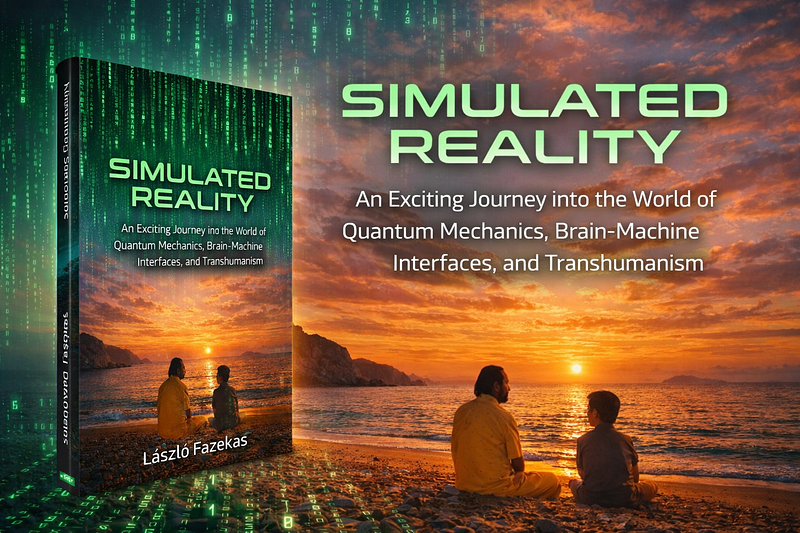
The idea that the reality we experience is nothing more than an illusion is almost as old as humanity itself. Many religions touch on this concept. One of the earliest non-religious mentions can be traced back to the philosopher Plato and his famous Allegory of the Cave.
In Plato’s thought experiment, prisoners are chained inside a cave from birth. Their only connection to the outside world is the shadows cast on the opposite wall by a light streaming through an opening. For them, these shadows are the world. Should one of them escape, the true world beyond the cave would feel alien and incomprehensible.
Although Plato intended the allegory to explain his theory of Forms and the nature of knowledge, it is difficult not to see clear parallels with modern interpretations. Consider the universe of The Matrix, where humans live their entire lives restrained, immersed in a fabricated world projected into their minds by intelligent machines. It is essentially a 2,000-year-old idea retold with modern technology. The simulation hypothesis is a rethinking of Plato’s cave.
I must have been six or eight years old when this question first formed in my mind: What if what I’m experiencing isn’t real? What if my life is nothing more than a reality show, like The Truman Show, or I am simply a brain in a vat, kept by aliens like a strange houseplant or exotic pet — entertaining them as they watch my life unfold on some enormous television screen?
And I don’t think I’m alone in this. Nearly everyone, at some point in their life, wonders: Is this truly reality? Could this all be just a dream — maybe a bad one, or perhaps a very good one?
But for me, the idea never let go. I have always been driven by a deep curiosity about how reality truly works. As a teenager, I promised myself that one day I would write a book on the subject. Now, nearly thirty years later, that promise has finally been fulfilled.
Since I had already written articles on most of these topics on HackerNoon and here on Medium, I initially thought it would be enough to simply compile them into a book. I was wrong. 🙂
When I reread the articles, I realized I wasn’t fully satisfied with them anymore, so instead I rewrote everything from scratch. Many new ideas emerged in the process, and my thinking has changed in significant ways over the past few years.
In the end, what I had expected to put together in a few weeks turned into a year-long project — because, in practice, I ended up writing the entire book anew.
The book is divided into three main parts:
Part One makes the case for the Simulation Hypothesis — the idea that our world may already be a form of illusion. To explore this possibility, it draws on modern physics, introducing the reader to theories such as relativity, quantum mechanics, the neural-network model of the universe proposed by Alexey Vanchurin, and the free energy principle developed by Karl Friston.
Through famous thought experiments and paradoxes — such as Schrödinger’s Cat, Wigner’s Friend, and the unsettling notion of Boltzmann brains spontaneously emerging from nothing — the book reveals just how strange reality may be beneath the surface. Taken together, these ideas suggest that the world is far more bizarre than we tend to assume, and that the possibility of reality being an illusion cannot be dismissed so easily.
Part Two turns to the question of how we might create simulations of our own. It takes a close look at the possible ways simulated realities could be built in the future, and at the directions in which current research and emerging technologies are pointing.
The reader is introduced to the world of brain–computer interfaces, gaining insight into approaches that go beyond Neuralink, as well as into what developments may lie ahead.
The section also argues that simulated realities could offer a genuine solution to sustainability, because many of humanity’s most pressing problems can be traced back to overconsumption. If a significant portion of our consumption were shifted into virtual worlds, the physical strain we place on the planet could be dramatically reduced. In this sense, virtualizing consumption may address not just environmental challenges, but a large share of humanity’s interconnected problems.
Part Three looks toward possible futures. It explores transhumanism — the pursuit of immortality and the transformation of our species from Homo sapiens into what Yuval Noah Harari calls Homo deus, a “god-like human.” In this vision, we may one day transcend our biological bodies altogether, choosing instead to exist within digital universes of our own creation.
The book further argues that this trajectory may not be unique to humanity. Any sufficiently advanced intelligent species, it suggests, would be driven toward an optimal state — one defined by digital existence within simulated worlds. From this perspective, Part Three offers not only a glimpse into humanity’s future but also a way of thinking about advanced intergalactic civilizations. Perhaps such civilizations are not absent from the universe at all; perhaps we fail to find them because they are running simulations like ours, and therefore must be sought not within our world, but beyond it.
Each part begins with a short science fiction story — designed to spark curiosity and prime the imagination for what follows. I hope my readers will find them enjoyable.
Although writing the book took far longer than I had originally expected, I enjoyed every minute of it. It is a blend of science, technology, physics, philosophy, and a touch of science fiction — along with a tribute to pop-culture masterpieces such as The Matrix—everything that I love.
I hope that reading this book will bring at least as much joy as writing it did. If it does, then it was all worth it.
If you’re interested in the book, you can purchase the eBook format from the Amazon Kindle Store. It is available at the minimum price until the end of March 2026.
And if you enjoy it enough to want a copy on your own bookshelf, a hardcover and a paperback edition are also available.
From Plato's Cave to The Matrix, this ancient idea returns again and again-humanity has always wrestled with a single…www.amazon.com
If you truly enjoyed the book, you can also help a great deal by leaving a rating or writing a short review. I don’t expect the book to generate significant revenue — I didn’t write it for that reason, but rather out of passion and enjoyment.
What I do hope, however, is that it reaches as many people as possible, and positive reviews make a real difference in that regard.
Thank you for your support.
For more info, please check the book's webpage.
Simulated Reality is an accessible journey through the simulation hypothesis, quantum mechanics, brain-machine…simulatedrealitybook.com
I’ve generated a short podcast about the book by NotebookLM. If you are interested, you can access it on Spotify.
Are we living in a simulated reality?This episode explores Simulation Theory, Quantum Mechanics, Brain-Computer…spotifycreators-web.app.link
And a short introduction video is also available on YouTube.
The technology isn't perfect yet, but I hope you will enjoy it.